A second life
for a wild
flower.
Exploring carbonized Parthenium as a filter coating for pharmaceutical contaminants in water.
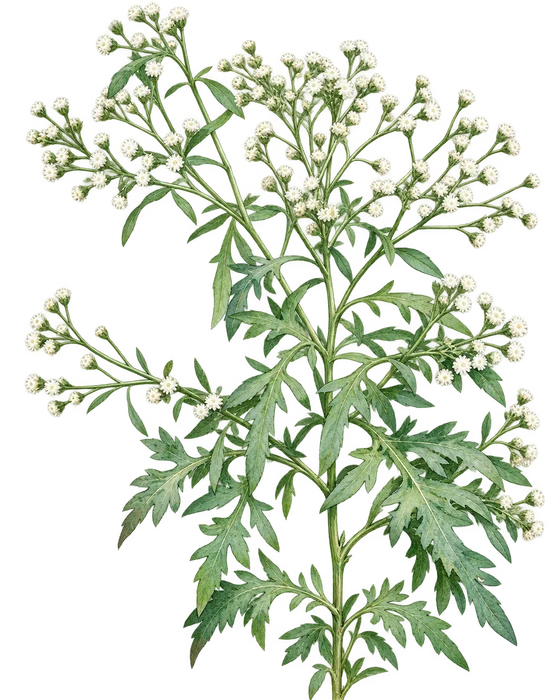
An invasive plant. A research question.
Could an abundant weed become a useful material
for water treatment?
From an invasive plant
to a material worth studying.
Parthenium grows readily and is often treated as a nuisance. This project asks whether its carbonized biomass could serve a more useful purpose: as a coating on filter paper.
-
Prepare the biomass
Process Parthenium leaves by solvothermal treatment at 200 °C for 18 hours. Wash and dry the resulting material.
-
Coat the paper
Disperse the prepared material and deposit it onto Whatman Grade 41 filter paper.
-
Test the filtrate
Pass a ciprofloxacin tablet preparation through the filter and compare UV–visible absorbance.
An exploratory laboratory study. Further controls and repeat testing are needed.
The material, up close.
Explore the filter, the microscopy panel and the spectral figures included in the manuscript.
Microscopy panel
Included in the manuscript; sample provenance is not documented.
From carbon to filter
Recovered solid, left, and coated paper supports, right.
FTIR spectrum
Qualitative trace; the original vertical scale requires verification.
UV–visible comparison
Before and after filtration. An optical screening result.
Select any figure to view it in detail.
Figures from the supplied research manuscript.
Early findings
A promising signal.
An open question.
37.5%
lower absorbance in one preliminary comparison.
This is a screening result, not a validated measure of ciprofloxacin removal. Replicates, control filters and chemical confirmation are still needed.
Watch the study.
Read the details.
A project presentation, a short synopsis and the full paper with the carbon images.